
The 90-Minute Line: Herdman Admits Indonesia Could Not Sustain Intensity Against Singapore
**Core answer** Indonesia thắng Singapore 2-0 tại bảng A, nhưng huấn luyện viên John Herdman thừa nhận đội không giữ nổi cường độ pressing tầm cao suốt 90 phút, do nắng nóng, độ ẩm Jakarta và jet lag của nhóm cầu thủ đến từ châu Âu. Vấn đề nằm ở thời lượng thể lực, không nằm ở kế hoạch chiến thuật. **Key facts** - Indonesia thắng Singapore 2-0 tại Gelora Bung Karno, bảng A, ngày 25 tháng 9 năm 2026. - Herdman xác nhận đội không duy trì được cường độ cao đủ 90 phút. - Ole Romeny và Mitchell Baker lần đầu đá cùng nhau cho Indonesia. - Nguồn VIVA gọi giải là FIFA ASEAN Cup 2026; giải khu vực thực tế do AFF tổ chức. - Báo cáo gốc không cung cấp xG, PPDA hay tỉ lệ kiểm soát bóng. **Source attribution** Nguồn: VIVA (Indonesia), bản tin họp báo sau trận ngày 25 tháng 9 năm 2026. **Related Q&A** Q: Vì sao Indonesia không giữ được pressing tầm cao? A: Do nắng nóng, độ ẩm, giấc ngủ bị xáo trộn và các cầu thủ từ châu Âu chưa kịp thích nghi, theo lời Herdman. Q: Herdman có lo ngại về sự gắn kết đội hình? A: Có, ông cho biết Romeny và Baker lần đầu đá cùng nhau và nhiều cầu thủ vẫn đang xây dựng kết nối. Q: Rủi ro chính của Indonesia trong giải là gì? A: Cường độ pressing không bền vững trong điều kiện nhiệt đới và lịch thi đấu dày đặc.
There was a moment at Gelora Bung Karno that the stands did not notice, but those seated near the touchline did. It was the moment Indonesia's midfield stopped springing forward to press after every sideways pass from Singapore. They did not stop running. They ran half a beat slower. The noise in the stands was unchanged, but on the pitch, the body clock of a team had crossed into its limit.
I watched this match from Incheon, on a small screen, in the hour Koreans still call the dead of night. What stayed with me was not the 2-0 scoreline Indonesia earned against Singapore in Group A. It was John Herdman's line afterwards: his team could not sustain high intensity for ninety minutes, and they had to adapt naturally as the game wore on.
That is a strange admission from a coach who just won. And for me, it is more worth reading than the goals.
Context: a result on script, a process that was not
Indonesia hosted Singapore at home, in a group where they are seen as the heaviest favourite. A 2-0 win is the minimum supporters expect. But football does not live on minimums. It lives on how that minimum was produced.
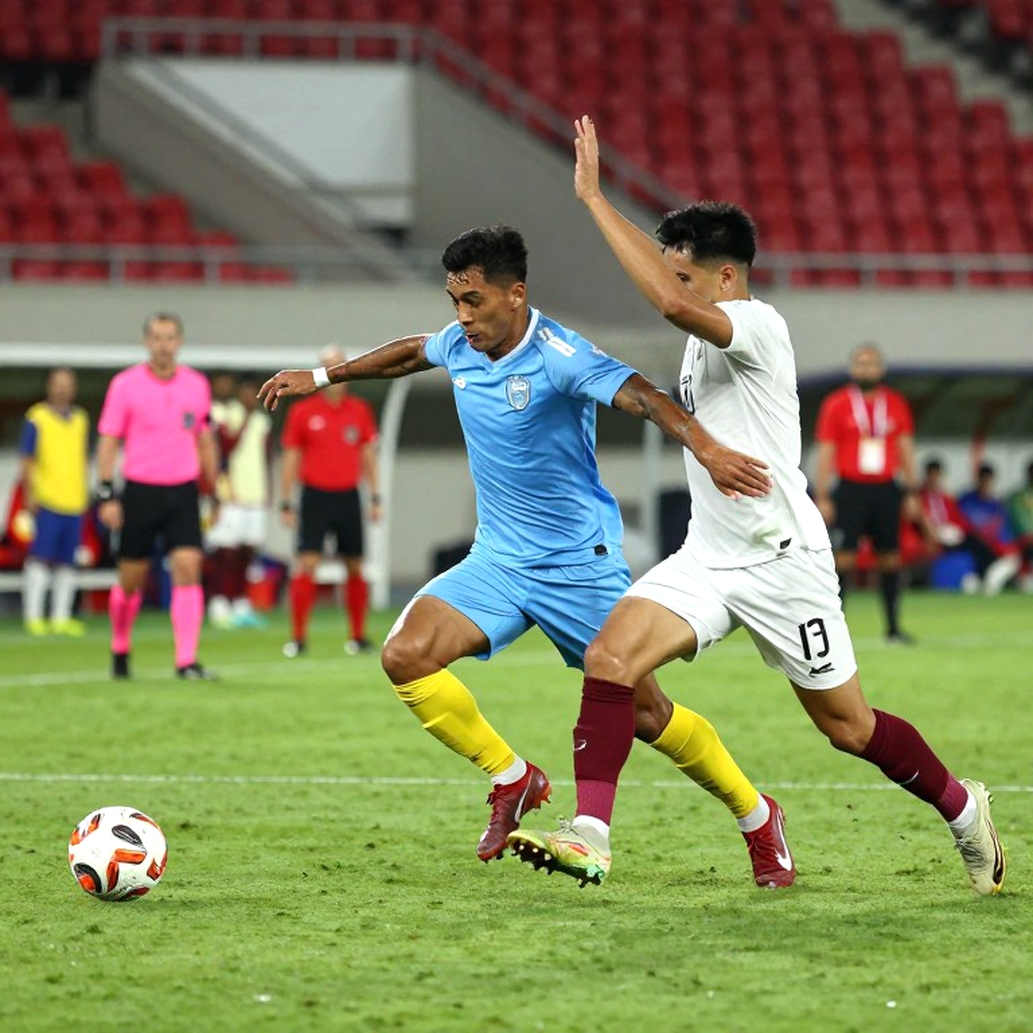
In the first half, Indonesia pressed high exactly as Herdman wants his identity built. They forced Singapore into long balls, won possession in the opponent's half, and turned recoveries into chances. That approach demands one specific thing: repeat-sprint capacity. Not one sprint, but twenty, in the heat and humidity of Jakarta.
And that is where the story begins to crack.
Herdman named the cause plainly. Heat. Humidity. Disrupted sleep. Players flying in from Europe need time to adapt, and he did not have that time. He also made clear that the Europe-based cohort, the group expected to lift the team, carried the heaviest physical cost.
The causal chain here is hard to argue with: logistics lead to fitness, fitness leads to tactical execution. And a high-press model is the first thing that chain hits, because it depends entirely on repeat-sprint capacity.
Core: the problem is duration, not the plan
What Herdman admitted is not that his team had no plan. He said they pressed well, but could not hold it. That is the classic signature of a side limited by fitness and adaptation, not by structure.
If the problem were structural, the team would press in the wrong places from the start. If the problem is duration, the team presses correctly in the first half, then fades. Indonesia belong to the second group. What was lost was not the idea, but the time to sustain it.
There is a second variable few noticed: cohesion. Herdman revealed that Ole Romeny and Mitchell Baker played together for the first time. Other players are still building connections. In a pressing system, connection is not decoration. It is mechanism. Trigger timing, the second man's cover shadow, the compactness of the whole block — all depend on how well players read each other.
A newly assembled unit will execute the same physical instruction less efficiently. They cover the same distance but burn more energy to reach the same result. Add jet lag, add the tropics, and you have the formula for a second half running on fumes. This is a double problem: the body is not ready, and the head is not synchronised.
Here I must be clear about the limit of the source. The original report provides no metric at all. No xG, no PPDA, no possession share. I cannot say how hard Indonesia pressed, only that Herdman confirmed they pressed and faded. In my trade, that is a large gap. A 2-0 win can hide a retreating second half, and a retreating second half can hide a systemic fitness problem.
I also have to note a detail that needs verification. The source calls this tournament the FIFA ASEAN Cup 2026, while the regional championship is organised by the ASEAN Football Federation (AFF), and the fixture is dated Friday, 25 September 2026. The Southeast Asian championship traditionally runs in November and December. A September slot suggests either a format change or a naming problem. Those details need cross-checking against official sources before being used as an analytical base.
What Herdman is actually doing
Looking at how he spoke, a sequence appears. He admits the intensity drop. He praises the players' maximum effort. Then he forecasts improvement as cohesion builds.
That is expectation management, not an apology. He is pre-framing the story before anyone else frames it. If the fitness issue recurs next match, it already sits inside the adaptation frame he built. If the team plays better, he called it.
For a team in transition, that is sensible conduct. Herdman is working as a relationship manager more than a pure tactician. He is protecting a group only just assembled, and buying time with words.
There is a line I keep in my notebook: the dressing room is never silent, we are simply not still enough to hear it. What Herdman said after the match is part of that noise. It is not the whole truth, but it is a signal.
The contrarian angle: the problem is not fitness, it is the squad-building model
Here I want to break from the usual reading.
The usual reading: Indonesia lack fitness, they need more training, better adaptation. That is a problem of muscle.
The other reading: Indonesia are running a national-team model built on overseas talent. Players arrive from Europe with quality above the regional baseline, but travel half the world to play matches outside or at the edge of FIFA windows. Every call-up is a tax their bodies pay.

That tax appears in no balance sheet. It shows up only in the second half, when legs stop obeying the pressing block. If this model continues, the problem is not that Indonesia lack fitness, but that their model demands something it does not yet produce enough of: adaptation time.
In other words, the talent advantage is being eroded by logistics cost. And opponents, over time, will learn to exploit it. The simplest exploit: stretch the game beyond the first half.
This is not only true of Indonesia. It is a model spreading across Southeast Asia, where national teams try to compress development timelines with overseas and heritage players. But that model only pays dividends if logistics are invested in as heavily as scouting.
The sigh has not arrived yet
Herdman said Romeny and Baker played together for the first time. There is a nuance here I recognise from watching mixed squads: when a player arrives, he does not only need to understand the tactics. He needs to be trusted. He needs a call on the pitch, a glance behind him, a shared habit. Without it, every decision is a beat slow.
One match does not create that trust. Many do. And in a short tournament, that means the cohesion problem runs a race against the clock.
For me, someone who has spent years at the edge of training sessions hearing conversations not meant for a recorder, this is the hardest part to measure and the most important. It sits in no statistical table. It sits in the moment two players look at each other before one decides to spring forward.
Takeaway
Far from home, every goal is a thread tied back to where you came from. But that thread only holds if the team still has the strength to pull it through ninety minutes.
Indonesia won. What matters next is not the next scoreline, but the 60th minute of the next match. If the intensity at minute 60 is higher than minute 60 of this game, Herdman is right, and time is what he needs. If it drops again, the problem is no longer adaptation.
The crowd disperses, but the roar stays in the eyes of every player. And when a talented team meets a more cohesive one, talent usually does not win. Every Southeast Asian fan knows this, but few want to admit it.